Wednesday, November 11, 2009

Bowl of Hygieia


Another image from Madrid. This was indicating that the business was a pharmacy. According to Medhunters the cup is called the bowl of Hygieia, from which we get the term hygiene. Hygieia was the daughter of Asciepius, the god of medicine in Greek mythology. Hygieia was the goddess of health, cleanliness and sanitation. The snake became a symbol of Asciepius as well as for Hygieia.

Tuesday, November 10, 2009

Madonna Obscured


I spent most of last week in Spain both in Barcelona and Madrid. While strolling about the huge Madrid flea market on Sunday I spotted this Madonna with obscured face decorating a nearby building. While it may be my own preconception of the Spanish Catholic culture, nevertheless this image seems to reflect some of the conflict that is inevitable in most free societies.

Thursday, October 22, 2009

Brian Ulrich goes dark

Brian Ulrich is a recent recipent of a Guggenheim grant for photography. As of this writing he has several recent images up at the Robert Koch Gallery in San Francisco, where I caught up with them yesterday. Ulrich is known for observing popular culture at the consumer level, having photographed both people and the environments in which they shop. Brian Ulrich's previous exhibition at Koch contained two memorable images, one outside a grocery dairy case in which milk had been spilled, and another that showed a window sign purporting to show that day's homeland security threat level, but which shows only the sky beyond. Cheerfulness and humor are never far from view.

In the recent body of work, Dark Stores, Ulrich, for the most part, goes outside of the shopping environment to feature the boxy container where modern consumers do their consuming, or in this case--used to consume--since all are now failed businesses. Stores come and go all the time, but these pictures seemed timed for the current economic environment. The photographs are large and lush with subject matter that suggests an artist's purpose rather than a documentarian one, but ultimately we're left with desolate architecture and any echos of the absent shopper are long gone. Remembering Ulrich's earlier pictures one can't imagine not wanting to return to happier times.

Ulrich's strength is in not beating around the bush. His photographs are accessible in a way that much large scale contemporary color work isn't. The viewer feels that they know what point is being made while at the same time is fully entertained pouring over the minute detail and his effective use of color.

Friday, September 18, 2009

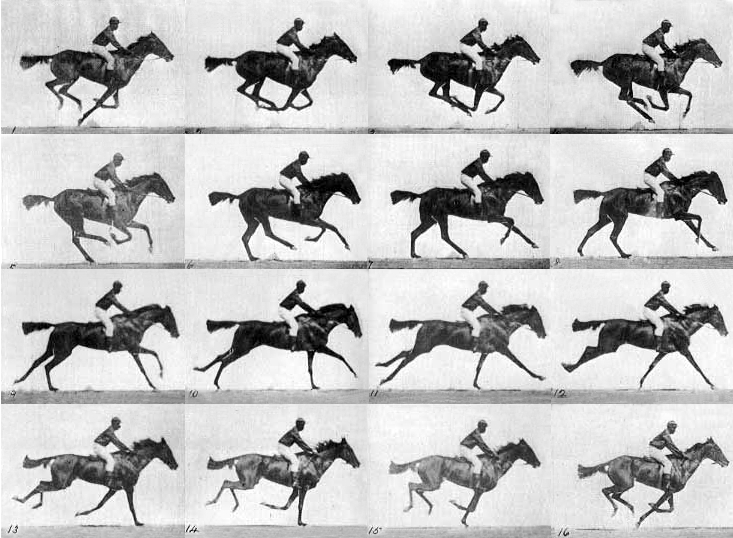
Muybridge


Anyone aquainted with the early history of photography will recognize the name Eadweard Muybridge. It is popularly understood that in 1878 Muybridge's photographs validated California governor Leland Stanford's assertion that a horse at gallop will have all four legs in the air simultaniously. Muybridge came up with a plan to photograph Stanford's horse Occident with a series of cameras whose shutters were activated by electrical triggers designed by John D. Isaacs who was the chief engineer for the Southern Pacific Railroad.


The experiment took place on Leland Stanford's farm which became Stanford University. What many people may not know is the location of this famous experiment continues its history with horses. The Red Barn at Stanford is a campus equestrian center, and the historic location is commemorated with a plaque in the honor of Leland Stanford, Eadweard Muybridge and John D. Isaacs. Note that the largest name on the plaque goes to the founder of Stanford University rather than those most remembered by the experiment.


While working on the Stanford's horse photography experiment, Muybridge shot and killed a local mayor who he suspected of alienating the affections of Muybridge's wife. The photographer was judged to be not guilty.

Saturday, August 22, 2009

printing on tracing paper


I've recently started printing photos on tracing paper. When the initial attempts failed to produce strong enough blacks I started to add layers of tracing paper prints to give the desired density. The transparency/translucency effect left me wondering how to advance the image making process. At first I cut away portions of the underlying image. Next I began coloring the images from behind. Each of these didn't seem quite right somehow.

After processing about 50 prints I was content to let the images be themselves. But then a chance encounter with an automobile roadmap gave me the next idea of adding a map layer to the image. In the example above the map is a lunar map of suggested landing sites. Click the images to enlarge.

Friday, August 21, 2009

Tuesday, August 11, 2009

People Pictures


(click photo to view large)

Back before pixels formed images there existed photographers who marshalled the assembled mass of military bodies, religious groups and others into human pixel-like formations as incredible as any in the history of photography. The studio of Mole & Thomas concocted photos with names such as The Living Uncle Sam, The Human American Eagle, or The Human Statue of Liberty that were the combined efforts of the photographers and the thousands of men in uniform that were required to render these images. It is emblematic of a big vision, skillful execution and human patience seldom known today.

The Carl Hammer Gallery in Chicago has several Mole & Thomas images in their inventory. This website gives you an idea of the distortion required to achieve a believable effect with 10,000 to 30,000 people.

According to Cabinet Magazine Arthur Mole's family came to the United States from England to follow the religious teachings of Dr. John Alexander Dowie a Christian utopian who had established a large church as well as the city of Zion, Illinois. The church's choir director John Thomas was enlisted to help Mole with some of his early formations using the church choir. The pair then teamed up to produce succeeding images.

Mole and Thomas began by tracing the image they wanted to produce on the ground glass of an 11x14 view camera. According to Cabinet Magazine "Using a megaphone, body language, and a long pole with a white flag tied to the end to point to the more remote areas where the bulk of the troops had to be stationed, Mole would then position his helpers on the field as they nailed the pattern to the ground with miles of lace edging. In this way, Mole also figured out the exact number of troops required." The photos often took a week or more to complete.